I taught for over thirty years.
Somewhere in the middle of that, I came across a Japanese word — Yoin — that did something I could not do for myself: it gave me one word for what I had been trying to do all along.
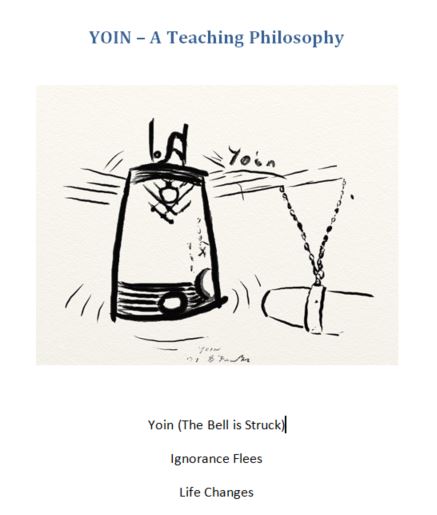
Howard Rheingold, in his book of untranslatable words, defines Yoin as “experiential reverberation that continues to move you long after the initial external stimulus has ceased.” The bell is struck. The bell stops being struck. The bell goes on ringing inside the listener.
That is what teaching is.
Or that is what teaching is when it works. Most of the time, in the moment, you don’t know whether you’ve struck the bell at all. You stand at the front of the room, you say what you came to say, the students nod or do not nod, the period ends, they leave. You may never know what kept ringing. Some of them, you find out years later — a letter, a passing comment at a graduation, a chance meeting in an airport. Most of them, you never know.
You teach anyway. That is the whole job, condensed: teach as if the bell will keep ringing, even when you cannot hear it.
The Apprentice and the Master
The framework that fit Yoin most cleanly, when I went looking for one, was Daniel Pratt’s Apprenticeship Perspective. I took Pratt’s Teaching Perspectives Inventory partway through my career, half expecting to be told my answers added up to something I had not chosen. They added up to Apprenticeship.
Pratt described the apprenticeship teacher as a skilled practitioner of the craft, one who reveals the inner workings of skilled performance and translates it into accessible language. Who knows what their learners can do on their own and where they need guidance. Who offers less direction and more responsibility as the learner matures. Who works inside what Pratt called the zone of development.
I had been an apprentice mechanic, in another life. I had been an apprentice farrier — a blacksmith for horses. I knew what an apprentice was, from the apprentice’s side. What took me longer was understanding the role of master.
Master is not a fashionable word. It is open to misuse and worth saying carefully. I do not mean master over the apprentice. I mean master of the craft — one to look up to, one to emulate, one whose skill in the work is the curriculum. The teacher does not demonstrate authority. The teacher demonstrates the work, and lets the work do the teaching.
That distinction landed late and stayed.